Choosing between OEM and ODM cosmetics is one of the first strategic decisions every beauty brand must make. The manufacturing model you select will directly influence your product uniqueness, development cost, launch timeline, intellectual property, and long-term competitiveness.
While both OEM and ODM allow brands to outsource production, they serve very different business objectives. OEM focuses on customized product development, whereas ODM provides ready-to-market formulations that accelerate market entry.
This guide explains the key differences between OEM and ODM cosmetics, compares costs, lead times, customization options, and ownership, and helps you determine which model best fits your business goals.
✔ OEM offers maximum product customization and formula ownership.
✔ ODM enables faster product launches with lower upfront investment.
✔ OEM generally requires higher MOQs and longer lead times.
✔ ODM is ideal for startups testing the market.
✔ Many successful brands start with ODM before transitioning to OEM.
OEM and ODM cosmetics differ primarily in how products are developed and customized. OEM is the better choice for brands seeking exclusive formulations, full product customization, and long-term brand differentiation, while ODM is ideal for businesses that want to launch products quickly using proven formulations with lower upfront investment.
In general:
Choose OEM if your priority is developing proprietary products, creating a premium brand, or building long-term competitive advantages.
Choose ODM if you want to reduce development costs, shorten lead times, test new markets, or launch a private label cosmetics brand quickly.
Neither manufacturing model is universally better. The right choice depends on your business goals, available budget, launch timeline, and branding strategy. Many successful beauty brands begin with ODM to enter the market efficiently and later transition to OEM as their business grows and product differentiation becomes more important.
| If You Want To... | Choose |
|---|---|
| Launch products quickly | ODM |
| Reduce startup costs | ODM |
| Develop an exclusive formula | OEM |
| Build a premium beauty brand | OEM |
| Test market demand | ODM |
| Create long-term product differentiation | OEM |
OEM (Original Equipment Manufacturing) cosmetics refer to products that are developed and manufactured according to a brand's unique requirements. Instead of selecting an existing formula, the customer works with the manufacturer to create a product that reflects its own brand positioning, target market, and performance expectations.
In an OEM project, the brand has significant control over the product development process. This may include selecting active ingredients, adjusting textures and fragrances, designing custom packaging, and defining product performance. The manufacturer transforms these requirements into finished products while ensuring quality, regulatory compliance, and scalable production.
Compared with ODM manufacturing, OEM offers greater flexibility and product differentiation, making it the preferred choice for brands that want to establish proprietary formulations or create a unique competitive advantage in the market.
A professional OEM cosmetics manufacturer typically provides comprehensive support throughout the product development process, including:
Custom formula development
Ingredient sourcing and selection
Stability and compatibility testing
Sample development and optimization
Packaging design and sourcing
Manufacturing and filling
Quality control and regulatory documentation
OEM cosmetics manufacturing is commonly chosen by:
Established beauty brands
Premium skincare and haircare brands
Businesses seeking exclusive formulations
Companies developing innovative products
Brands focused on long-term market differentiation
Industry Insight
OEM manufacturing is more than simply producing cosmetics—it is a collaborative product development process. Experienced manufacturers work closely with brands to refine formulations, optimize packaging, and ensure the final product meets both market expectations and regulatory requirements. For companies looking to build lasting brand value, OEM provides the flexibility needed to create products that competitors cannot easily replicate.
ODM (Original Design Manufacturing) cosmetics are products based on formulations that have already been developed, tested, and validated by the manufacturer. Instead of creating a new formula from scratch, brands choose from an existing product portfolio and customize branding elements such as logos, labels, packaging, and product names before launching them under their own brand.
Because the research, formulation, and manufacturing processes are already established, ODM enables businesses to reduce development costs, shorten lead times, and bring products to market much faster than OEM manufacturing. It is an efficient solution for companies that want to launch high-quality cosmetics without investing heavily in product development.
A typical ODM project follows a streamlined process:
Select products from the manufacturer's existing formulation library.
Request product samples for evaluation and testing.
Customize branding, labels, packaging, and artwork.
Confirm product specifications and packaging design.
Begin mass production and quality inspection.
Complete packaging, shipment, and delivery.
Since the formulations have already undergone development and testing, the process is faster and involves fewer technical revisions than OEM manufacturing.
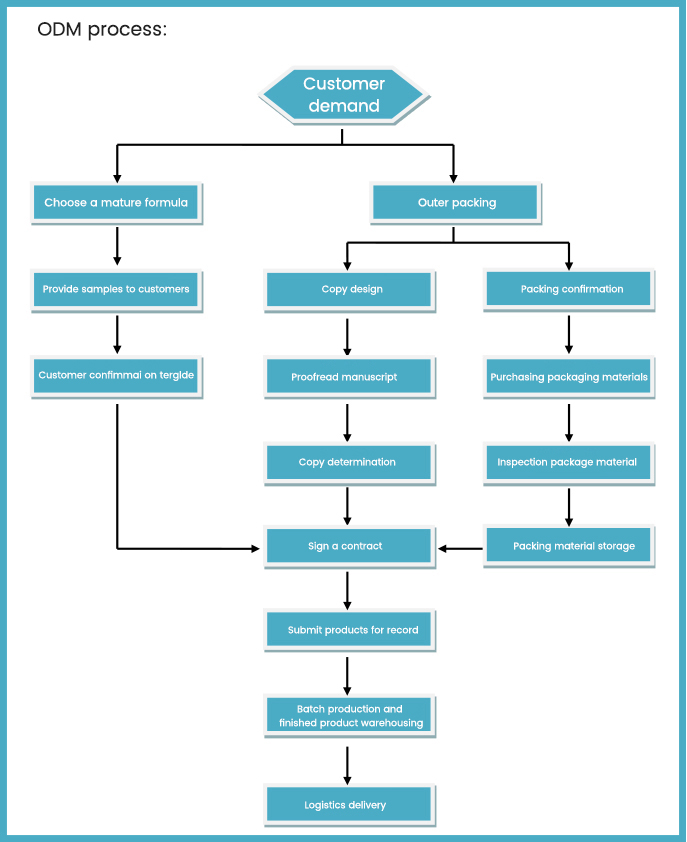
ODM manufacturing offers several advantages for growing beauty brands:
Faster time to market with ready-to-use formulations
Lower upfront investment and reduced development costs
Proven formulas with established production processes
Professional manufacturing and quality control
Flexible branding and packaging customization
Lower technical barriers for new businesses
ODM cosmetics manufacturing is ideal for:
Startup beauty brands
Private label businesses
E-commerce and Amazon sellers
Retailers and distributors
Businesses testing new markets
Companies launching seasonal or trend-driven products
Most cosmetic manufacturers offer a wide range of ready-to-market formulations, including:
Facial Cleanser
Serum
Toner
Moisturizer
Body Lotion
Sunscreen
Shampoo
Conditioner
Hair Mask
Hair Oil
Face Mask
Body Scrub
Industry Insight
ODM manufacturing is often the fastest route to launching a beauty brand. Many successful companies use ODM products to validate customer demand and build market presence before investing in OEM development for exclusive formulations. Choosing a manufacturer that provides both ODM and OEM services also allows brands to transition smoothly as their business grows and product requirements become more specialized.
Choosing between OEM and ODM is more than selecting a production method—it is a strategic business decision that can influence your brand's success for years to come. The manufacturing model you choose affects everything from product development and investment costs to market positioning and long-term competitiveness.
Before partnering with a cosmetics manufacturer, it's important to evaluate your business objectives, available resources, and growth plans. While OEM offers greater flexibility and exclusivity, ODM provides a faster and more cost-effective path to market. Understanding these trade-offs helps ensure your manufacturing strategy aligns with your brand's current needs and future goals.
✔ Brand Positioning
✔ Development Budget
✔ Product Differentiation
✔ Time to Market
✔ Scalability
Expert Tip
There is no one-size-fits-all solution. The right manufacturing model depends on your business stage, target market, product strategy, and long-term growth objectives. Evaluating these factors before starting a project can help reduce development risks and maximize your return on investment.
Table 1. OEM vs ODM Overview
| Feature | OEM | ODM |
|---|---|---|
| Formula | Custom | Ready-made |
| Development | Customer-led | Manufacturer-led |
| Investment | Higher | Lower |
| Launch Speed | Slower | Faster |
| Customization | High | Moderate |
| Formula Ownership | Customer* | Manufacturer |
| MOQ | Higher | Lower |
Expert Tip
The best manufacturing model depends on your business goals. Companies focused on product differentiation often choose OEM, while businesses prioritizing speed and lower startup costs frequently select ODM.
Every cosmetics brand has different product development requirements. Some businesses need exclusive formulations tailored to a specific market, while others prioritize launching proven products as quickly as possible.
OEM manufacturing supports custom product development from concept to commercialization, whereas ODM allows brands to select formulations that are already production-ready.
| Development Stage | OEM | ODM |
|---|---|---|
| Formula Development | Customer-driven | Manufacturer-developed |
| Product Testing | Custom | Pre-tested |
| Development Time | Longer | Shorter |
| Technical Involvement | High | Low |
The level of customization directly affects how your products stand out in a competitive market. Businesses focused on building premium brands often require greater control over ingredients, textures, fragrances, and packaging, while others may only need customized branding.
| Customization | OEM | ODM |
|---|---|---|
| Formula | ✔✔ | Limited |
| Active Ingredients | ✔✔ | Limited |
| Fragrance & Texture | ✔✔ | Limited |
| Packaging | ✔✔ | ✔✔ |
| Label Design | ✔✔ | ✔✔ |
| Brand Identity | ✔✔ | ✔✔ |
Budget and production timelines are often the deciding factors when selecting a manufacturing model. While OEM requires more development work, ODM minimizes both investment and time by using formulations that are already validated.
| Factor | OEM Cosmetics | ODM Cosmetics |
|---|---|---|
| Initial Investment | Higher due to custom development | Lower with ready-made formulations |
| Formula Development | Required | Not Required |
| Lead Time | 60–90 Days | 30–60 Days |
| MOQ | Usually 3,000+ Units | Usually 500–3,000 Units |
| Product Development Cost | Higher | Lower |
| Time to Market | Longer | Faster |
Buyer Consideration
While ODM offers lower costs and faster market entry, OEM provides greater product exclusivity and long-term brand value. Rather than focusing solely on price or production speed, businesses should evaluate which manufacturing model best supports their branding strategy, target market, and future growth plans.
In OEM manufacturing, formulations are often developed specifically for one customer. Depending on the manufacturing agreement, the brand may own the formulation or receive exclusive production rights. This allows businesses to build proprietary products that are difficult for competitors to replicate.
With ODM manufacturing, the manufacturer usually owns the original formulation and may supply similar products to multiple brands. Customers retain ownership of their trademarks, packaging designs, and brand identity, while the underlying formula typically remains the manufacturer's intellectual property.
| Feature | OEM | ODM |
|---|---|---|
| Formula Ownership | Customer* | Manufacturer |
| Formula Exclusivity | High | Limited |
| Trademark Ownership | Customer | Customer |
| Packaging Design | Customer | Customer |
| Brand Ownership | Customer | Customer |
*Formula ownership depends on the manufacturing agreement.
Before starting production, clarify the following with your manufacturer:
Who owns the final formulation?
Is the formula exclusive to your brand?
Will a Non-Disclosure Agreement (NDA) be signed?
Can the manufacturer sell the same formulation to other customers?
Who owns future formula modifications?
Are packaging designs and trademarks protected?
Formula ownership is only one part of intellectual property protection. A comprehensive manufacturing agreement should also define confidentiality, exclusivity, trademark usage, packaging ownership, and product development responsibilities to avoid future disputes.
| Business Priority | Recommended Option |
|---|---|
| Fast Launch | ODM |
| Lower Budget | ODM |
| Unique Formula | OEM |
| Premium Positioning | OEM |
| Product Exclusivity | OEM |
| Market Validation | ODM |
| Long-term Brand Building | OEM |
Rather than asking which manufacturing model is better, businesses should evaluate which option best aligns with their branding strategy, investment budget, launch timeline, and long-term growth objectives.
Every beauty brand has different priorities. Some businesses focus on launching products quickly to capture market trends, while others aim to develop proprietary formulations that support long-term brand growth.
Rather than recommending the same solution for every customer, experienced manufacturers evaluate each project individually before suggesting the most appropriate manufacturing model.
| Evaluation Factor | Why It Matters |
|---|---|
| Brand Positioning | Determines whether customization is necessary |
| Product Concept | Helps define formulation requirements |
| Development Budget | Influences OEM or ODM selection |
| Launch Timeline | Affects development planning |
| Target Market | Determines regulatory requirements |
| Annual Sales Forecast | Helps optimize MOQ and production planning |
| Packaging Requirements | Influences sourcing and production schedules |
| Future Product Expansion | Supports long-term manufacturing strategy |
Many emerging beauty brands begin with ODM manufacturing because it offers lower investment, shorter development cycles, and faster market entry. Once customer demand has been validated and sales become stable, many brands gradually transition to OEM manufacturing to develop exclusive formulations and strengthen product differentiation.
This phased strategy helps reduce initial business risks while creating opportunities for long-term brand growth.
Whether you are launching your first private label product or expanding an established cosmetics portfolio, partnering with a manufacturer that offers both OEM and ODM services provides greater flexibility throughout every stage of business growth.
At Rhine Cosmetics, our team supports customers with formulation development, packaging selection, manufacturing, quality control, and regulatory documentation, helping brands bring products to market efficiently while maintaining consistent product quality.
There is no universally better manufacturing model. The right choice depends on your business goals, available budget, product strategy, and long-term growth plans. While OEM offers greater flexibility and exclusivity, ODM provides a faster and more cost-effective route to market.
The following comparison can help you determine which option best fits your current business stage.
| If Your Priority Is... | Recommended Option | Why |
|---|---|---|
| Launch products quickly | ODM | Uses proven formulations with shorter development cycles |
| Lower startup investment | ODM | Eliminates formulation R&D costs |
| Build a premium beauty brand | OEM | Supports exclusive product development |
| Develop proprietary formulations | OEM | Enables greater product differentiation |
| Test market demand | ODM | Lower financial risk for new product launches |
| Expand an existing product line | OEM | Allows greater customization and innovation |
| Shorter lead times | ODM | Existing formulas reduce production preparation |
| Long-term brand competitiveness | OEM | Creates stronger barriers to competition |
Many successful beauty brands do not rely exclusively on one manufacturing model. Instead, they adopt a phased strategy.
A common approach is to launch products through ODM manufacturing to enter the market quickly and validate customer demand. Once the brand gains market traction, the company gradually develops OEM formulations to create exclusive products and strengthen long-term competitiveness.
This approach balances speed, investment, and product differentiation while reducing business risks during the early stages of brand development.
Selecting the right manufacturing partner is just as important as choosing between OEM and ODM. A reliable cosmetics manufacturer should not only provide high-quality production but also support your business throughout product development, regulatory compliance, and future expansion.
Before selecting a supplier, evaluate the following capabilities.
Look for manufacturers with internationally recognized certifications, well-managed production facilities, and established quality management systems.
A strong R&D team can support formulation optimization, ingredient innovation, product testing, and future product upgrades as your business grows.
Choose a manufacturer capable of handling both current order volumes and future production expansion without compromising quality or delivery schedules.
An experienced supplier should provide packaging sourcing, artwork assistance, label compliance, and packaging compatibility testing.
Verify that the manufacturer can provide documentation required for your target markets, including ingredient information, product testing reports, and regulatory support.
Manufacturers with flexible production planning can better support startups, seasonal launches, and growing brands.
Working with an export-oriented manufacturer helps reduce communication issues and ensures smoother international shipping and documentation.
Rather than focusing only on the first order, choose a manufacturer capable of supporting future product development, production expansion, and ongoing technical assistance.
| Evaluation Area | Why It Matters |
|---|---|
| Certifications | Ensures manufacturing quality |
| R&D Capability | Supports innovation |
| Production Capacity | Ensures stable supply |
| Regulatory Support | Simplifies market entry |
| Packaging Services | Improves branding |
| MOQ Flexibility | Reduces purchasing risk |
| Export Experience | Facilitates global business |
Buyer Tip
A manufacturing partner should contribute more than production capacity. Strong technical support, transparent communication, and long-term collaboration often have a greater impact on brand success than price alone.
Many businesses misunderstand the differences between OEM and ODM manufacturing. Clarifying these misconceptions can help brands make more informed sourcing decisions.
Not necessarily. Product quality depends on formulation, raw materials, manufacturing standards, quality control, and the manufacturer's expertise—not whether the project is OEM or ODM.
While ODM formulations are pre-developed, many manufacturers offer customization options for packaging, branding, fragrances, textures, and certain formulation adjustments.
Although OEM projects generally require higher investment, many growing beauty brands choose OEM to develop differentiated products and strengthen long-term competitiveness.
Successful branding depends on product positioning, customer experience, packaging design, and marketing strategy. Many well-known brands began with ODM products before developing proprietary OEM formulations.
Before selecting an OEM or ODM manufacturing partner, consider the following questions:
☐ Define your brand positioning
☐ Confirm your target market
☐ Determine your development budget
☐ Estimate annual sales volume
☐ Verify manufacturer certifications
☐ Review MOQ requirements
☐ Confirm intellectual property ownership
☐ Request product samples
☐ Review production timelines
☐ Understand regulatory requirements
Choosing between OEM and ODM cosmetics is not about determining which manufacturing model is better—it is about selecting the solution that best aligns with your business objectives.
For startups and businesses seeking faster market entry, ODM offers a practical way to launch products with lower investment and shorter development cycles. For brands focused on innovation, exclusivity, and long-term differentiation, OEM provides greater flexibility to develop proprietary formulations and build stronger market competitiveness.
As your business evolves, your manufacturing strategy may evolve as well. Many successful beauty brands begin with ODM to establish market presence before transitioning to OEM as their product portfolio expands.
Partnering with an experienced cosmetics manufacturer that offers both OEM and ODM services gives your business the flexibility to adapt, innovate, and grow with changing market demands.
Ready to Launch Your Cosmetics Brand?Whether you're planning a private label product or developing a completely custom formulation, choosing the right manufacturing partner is the first step toward building a successful beauty brand. At Rhine Cosmetics, we provide both OEM and ODM manufacturing services, helping brands worldwide develop high-quality skincare and haircare products with flexible production solutions, professional R&D support, and reliable quality control. Contact our team today to discuss your next cosmetics project. |
The primary difference lies in product development. OEM (Original Equipment Manufacturing) creates cosmetics based on a brand's custom formulation or specifications, while ODM (Original Design Manufacturing) provides pre-developed formulations that can be customized with the customer's branding and packaging. OEM offers greater product differentiation, whereas ODM enables faster market entry with lower development costs.
For most startups, ODM is often the better choice because it requires less upfront investment, shorter lead times, and lower technical complexity. It allows new brands to test market demand quickly. As the business grows, many companies transition to OEM to develop exclusive formulations and strengthen brand differentiation.
Generally, yes. OEM projects usually involve additional costs for custom formulation development, laboratory testing, sample revisions, packaging validation, and regulatory documentation. ODM products use existing formulations, reducing research and development expenses and lowering the overall investment required.
OEM manufacturing often requires dedicated raw materials, custom packaging, and production planning, making higher minimum order quantities more economical for both the manufacturer and the customer. ODM products are based on existing production processes, allowing manufacturers to offer more flexible MOQs in many cases.
Yes. Although the core formulation is typically pre-developed, most manufacturers allow customization of branding, packaging, labels, fragrances, textures, and, in some cases, minor formula adjustments. The available customization options vary depending on the manufacturer.
Formula ownership depends on the manufacturing agreement. In OEM projects, the customer may own the custom formulation or receive exclusive production rights if specified in the contract. In ODM projects, the manufacturer usually retains ownership of the original formulation while the customer owns the brand, trademark, and packaging design.
Absolutely. Many beauty brands begin with ODM products to launch quickly and validate market demand. Once the brand has established a customer base, they often transition to OEM manufacturing to develop proprietary formulations and create stronger product differentiation.
The timeline depends on the complexity of the project, but most OEM cosmetics require approximately 60–90 days. This includes formulation development, sample approval, stability testing, packaging confirmation, and production. More complex formulations or regulatory requirements may extend the development period.
A reliable cosmetics manufacturer should have recognized quality and manufacturing certifications, such as GMPC, ISO 22716, and other certifications required by your target market. You should also evaluate the manufacturer's R&D capabilities, quality control system, regulatory support, and export experience.
Choose a manufacturer that offers strong research and development capabilities, reliable quality management, flexible production capacity, packaging support, regulatory expertise, and responsive communication. Ideally, work with a supplier that provides both OEM and ODM services so your manufacturing strategy can evolve as your business grows.